
 EN
EN
The first step in stock trading for beginners usually involves opening two accounts: a Demat account to hold the shares you buy and a trading account to place buy and sell orders in the market. Along with this, you need to understand the fundamental terminology and how the market works. This knowledge will enable you to make informed decisions aligned with your goals and risk appetite.
Key Takeaways
-
Start with basics: Open a Demat and trading accounts, learn key terms, and begin small to build confidence.
-
Understand market structure: primary vs secondary markets, equity, derivatives, and trading types like intraday and delivery.
-
Focus on discipline: use a plan, diversify investments, manage risk, and avoid impulsive decisions.
-
Build knowledge over time: use analysis methods, track trends, and align trades with financial goals and risk tolerance.
How To Invest In The Stock Market For Beginners?
Investing in the stock market can seem intimidating, but with basic knowledge and patience, it can be a rewarding wealth-building tool. Here are the essential steps for stock market investing for beginners in India:
-
Understand the basics: Before executing your first trade, it is crucial to have a basic understanding of how the market works. Start by learning about different asset classes, how stock exchanges (NSE and BSE) function, and the inherent risks involved.
-
Open a Demat and Trading account: To buy and sell stocks, you need a Demat account (to store shares) and a Trading account (to execute orders) with a registered broker. Choose a broker based on brokerage fees, user interface, and research services. Ensure your KYC (Know Your Customer) documents, such as PAN and Aadhaar, are ready.
-
Learn fundamental and technical analysis: To make informed decisions, it is important to learn both types of evaluation. Fundamental analysis involves assessing a company’s financial health via balance sheets and income statements, while technical analysis involves studying price charts to identify market trends.
-
Research and select stocks: After evaluating companies and understanding market trends, research and select stocks that align with your financial goals. You can use financial news portals and stock screeners to help you make an informed decision.
-
Invest small and diversify: When starting out, it is wise to invest small amounts and diversify your portfolio across different sectors (like IT, Banking, and Pharma). This helps mitigate risk and protects your capital from sector-specific downturns.
-
Monitor your portfolio: Once you have invested, regularly reviewing your investments is important to ensure they align with your original thesis. You should also stay updated on corporate actions and news related to the companies you hold.
-
Maintain a long-term perspective: The stock market can be volatile in the short term, but historically, equities have outperformed most assets over the long term. It is essential to avoid impulsive decisions driven by short-term market fluctuations.
Now that you know how to start your investment journey, remember that investing comes with risks. Do your due diligence and invest only capital that you do not need for immediate expenses. With the right approach and discipline, the stock market can be a powerful vehicle for long-term growth.
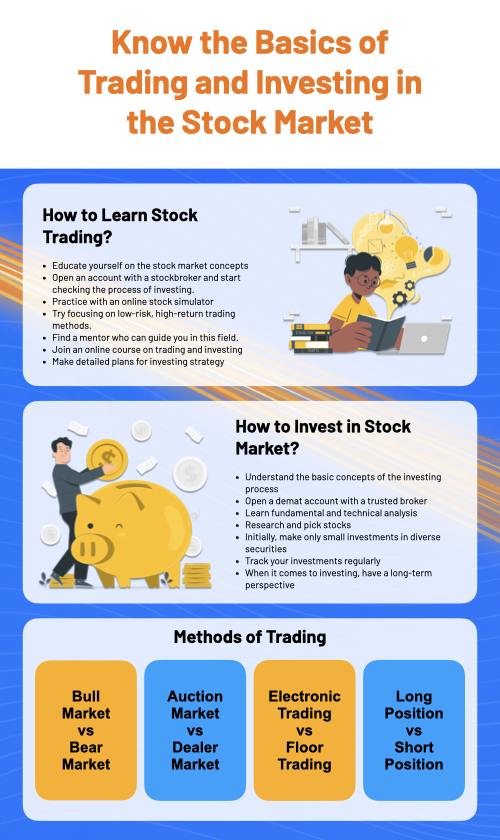
How to Learn Stock Trading?
Learning stock trading takes time, and most people pick it up step by step rather than all at once. It often begins with understanding how markets function and how prices move based on demand and supply. A steady approach usually works better than chasing quick outcomes.
Choosing an Online Trading Account
Pick a platform that feels simple to use. A clear interface helps track prices and place orders without confusion.
Educate Yourself
Read about basic terms such as equity, volume, and price trends. Short articles and official investor guides help build clarity.
Practice With an Online Stock Simulator
A simulator allows you to place trades without using real money. This helps in understanding mistakes without financial impact.
Choose the Low-Risk High-Reward Trading Method
Focus on trades where risk stays limited. Avoid large exposure in early stages.
Make a Plan
Define how much to invest and what kind of trades to take. A plan reduces impulsive decisions.
Find a Mentor
Learning from someone experienced can help avoid common errors.
Online/In-Person Courses
Courses explain structured concepts that may not be clear through self-study.
Share Market Basics
Learn how prices react to news, earnings, and overall market sentiment before placing trades.
What Are the Types of Share Markets?
Understanding the types of share markets helps you know where and how trades are conducted. The market is not a one-stop shop; it comprises multiple segments.
The main market, or primary market, is where firms offer shares. During initial public offerings, investors purchase shares directly, and capital enters businesses. Most trading takes place in the secondary market. Here, shares that have already been issued are bought and sold by investors. The prices of these shares fluctuate depending on demand and supply, among other factors.
The equity, derivatives, and debt segments offer various trading opportunities for different investment avenues.
-
Equity market: Company stocks.
-
Derivatives market: The contracts are correlated with an asset, such as futures and options.
-
Debt market: Debt instruments and fixed income.
In cash markets, shares are actually delivered, whereas in derivatives, settlement is through contracts in which no ownership is transferred. Beginners generally tend to enter equity markets and then venture into other segments.
Bull Market
A bull market is a market condition where there is a general trend of growth throughout the market. This is characterised by widespread optimism among investors and general confidence that prices will keep rising. A substantial rise in stock prices is seen during a bull market.
Example: Between April 2003 and January 2008, a major bull market trend was observed for about five years in the Bombay Stock Exchange Index (BSE SENSEX), which increased from approximately 2,900 points to 21,000 points.
Bear Market
A bear market is a market condition where there is a general trend of decline throughout the market. This is characterised by widespread pessimism and increased selling activity, where investors anticipate a continued decline in stock prices.
A substantial fall in stock prices is seen during a bear market. Typically, if a decline of about 20% from recent peaks is observed over a span of several months, it is said that the market has entered a bear period.
How Trading is Conducted
Understanding how trades are executed and positions are managed is essential for navigating the operational mechanics of the modern financial landscape.
Long Positions & Short Positions
An investor is said to hold a long position if he/she has bought shares and own them. On the other hand, if an investor sells shares they do not currently own by borrowing them, he/she is said to have a short position.
For example, if an investor has bought 500 shares of Company X, then he/she is "long 500 shares." This assumes the investor has paid the full amount for these shares.
However, if the investor sells 500 shares of Company X without actually owning them, he/she is "short 500 shares." This happens when an investor borrows shares from a brokerage firm into a margin account to sell them immediately. This investor now has a liability to repay 500 shares and must eventually purchase them in the market to "cover" the position and return them to the lender.
Electronic Trading & Floor Trading
The process of purchasing shares was very long and tedious before electronic trading emerged:
-
The investor calls the broker to place an order.
-
The broker calls the order clerk, who then relays the order to a floor broker.
-
The floor broker executes the order and transmits it to the order clerk, who then forwards it to the broker.
-
The broker then provides confirmation of the trade to the investor.
However, with the emergence of electronic trading, the entire trade execution process can be completed in a few seconds, as opposed to the several minutes required with the traditional floor or pit trading method. In addition to saving time, the investor also pays significantly lower brokerage costs when trading on an electronic platform. Consequently, the emergence of electronic trading platforms has led to a steep decline in the number of floor brokers.
Auction Market & Dealer Market
An auction market is where prices depend on the lowest price a seller is willing to accept (the Ask) and the highest price a buyer is willing to pay (the Bid). Sellers post competitive offers, and buyers post competitive bids. When a bid and an offer match, the transaction is made.
Example: There are 3 sellers willing to sell shares of Company X at ₹1200, ₹1250, and ₹1300. At the same time, there are 3 buyers willing to buy at ₹1100, ₹1150, and ₹1200. Thus, only the orders of the buyer and seller at ₹1200 will be executed since they have both agreed upon the same price.
A dealer market, on the other hand, is where market makers post their own selling and buying prices. They display their prices electronically, making the process transparent and providing immediate liquidity.
Example: Dealer A owns stocks of Company X. While other dealers quote a spread of 1300/1400, Dealer A posts a price of 1250/1350. Here, investors willing to buy will purchase from Dealer A because his "Ask" price is ₹50 cheaper than the competition.
Important Factors to Consider When Trading
When approaching stock trading, it helps to keep a few practical factors in mind before placing any trade. Many new traders focus solely on price movement, but a broader view often leads to better decisions. Learning from basic investor resources can provide a grounded starting point and reduce avoidable mistakes.
1. Investment Plan
A well-defined plan acts as a roadmap, outlining your financial goals, time horizon, and specific entry and exit strategies. Without a written plan, traders often fall prey to emotional decision-making during periods of high market volatility. Regularly reviewing and refining this plan ensures that your trading activities remain purposeful and disciplined.
2. Risks
Trading inherently has a risk of capital loss, influenced by market fluctuations, sector-specific downturns, or global economic shifts. Understanding your personal risk tolerance is critical to determining how much capital you can afford to risk in a single position. Identifying these risks allows you to prepare for "worst-case" scenarios rather than react in a panic.
3. Asset Diversification
Spreading your capital across different sectors, industries, and asset classes reduces the impact of a single poorly performing stock on your entire portfolio. Diversification ensures that if one asset class underperforms, it can be offset by stability in another. It is one of the most effective ways to manage unsystematic risk in a fluctuating market.
4. Capital Protection Measures
Utilising tools like stop-loss orders helps automate your exit strategy and prevents a minor setback from turning into a devastating loss. Position sizing, calculating exactly how much of your total account to risk per trade, is another vital layer of defence for your principal. Protecting your "downside" is often more important for long-term survival than chasing the maximum upside.
5. Market Trends
Recognising the broader market direction—whether it is a bullish uptrend, a bearish downtrend, or moving sideways—helps you align your trades with the prevailing momentum. Trading against a strong trend significantly increases the difficulty and risk of a position for most retail participants. Keeping an eye on technical indicators and moving averages can provide clarity on when a trend is strengthening or exhausting.
6. Long-term Performance
While short-term gains are attractive, evaluating a company’s multi-year track record of earnings growth and stability offers a more reliable picture of its health. Consistent historical performance often signals strong management and a resilient business model that can weather economic cycles. Focusing on long-term sustainability prevents you from being distracted by temporary, speculative price noise.
7. Portfolio Alignment
Every new trade should be evaluated based on how it fits into your existing collection of assets to avoid over-exposure to a single theme. For instance, adding a fifth high-growth tech stock might inadvertently increase your portfolio's sensitivity to interest rate changes. Ensuring each trade serves a specific role—whether for growth, income, or hedging—maintains a balanced financial structure.
8. News and Events
Corporate earnings reports, central bank interest rate decisions, and geopolitical developments can trigger sudden and sharp price movements. Staying informed about the economic calendar helps you anticipate volatility and adjust your positions before major announcements. However, it is essential to distinguish between impactful fundamental news and speculative market rumours.
Know Your Rights
Before entering into a contract with a broker, ensure they are registered with SEBI under the latest SEBI (Stock Brokers) Regulations, 2026. You have a right to transparency in all charges and direct credit of securities to your Demat account through the "Direct Payout" system. Ensure you receive a Consolidated Account Statement (CAS) for funds and securities monthly (if transactions occur) or half-yearly (if no transactions occur). You are also entitled to receive contract notes within 24 hours of a trade and have any grievances resolved within 21 calendar days through the SEBI SCORES or ODR (Online Dispute Resolution) platforms.
How Much Should You Invest?
Your risk appetite and financial goals should determine how much you should invest. Your investments should never compromise your essential emergency fund or savings intended for short-term liabilities. It is also important to diversify your portfolio across different asset classes (like equity, debt, and gold) and utilise features such as trailing stop losses to protect your capital from sharp market reversals.
Conclusion
Starting with online share trading does not require deep expertise on day one. Start with easy assignments: open accounts, get familiar with basic terms, and observe market behaviour. There are traders who put more emphasis on short-term price fluctuations, and those who are more inclined to hold stable positions. One-size-fits-all does not exist. It is all about being clear, patient and controlled in risk. By maintaining a measured pace, you can navigate online trading with clarity and avoid the pressure of impulsive decision-making.
