
 EN
EN
People aspiring to invest or trade in the stock market may be wondering which one to choose between NSE and BSE. These are the two principal stock exchanges in India where stocks are traded. The National Stock Exchange boasts of high trading volumes, Bombay Stock Exchange has a long history and broad listing base.
The indices like Nifty and Sensex are used to measure the general market trend and the performance of the leading companies. The actual point to a beginner is not which exchange is larger, but which platform is the most appropriate to their trading style and preference for stocks.
Key Takeaways
-
NSE offers higher trading volume and liquidity, which suits active traders and derivatives participants.
-
BSE has a wider list of companies, including many small and mid-cap stocks.
-
Both exchanges follow the same regulatory framework and offer secure trading systems.
-
For most investors, stock selection and long-term goals matter more than choosing NSE or BSE.
NSE and BSE: Which is Better for You?
BSE is often better for beginners due to its wider range of listed small and mid-cap companies, while NSE is the dominant choice for seasoned investors and active traders. BSE lists over 5,000 firms, making it ideal for a diverse selection of emerging or smaller companies. Conversely, NSE is preferred for high liquidity and trading derivatives, holding a near-monopoly in the derivatives segment.
NSE was also the first to introduce automated, high-volume trading. For long-term investors, BSE is a strong choice. While both exchanges follow SEBI-mandated tax structures like STT, they differ in transaction charges. NSE often offers tighter spreads due to higher volumes, while BSE may offer lower transaction fees in certain segments. Both offer robust services, are secure and provide good online services; hence, both are excellent choices.
Read More: What are Derivatives?
Comparison Between NSE and BSE
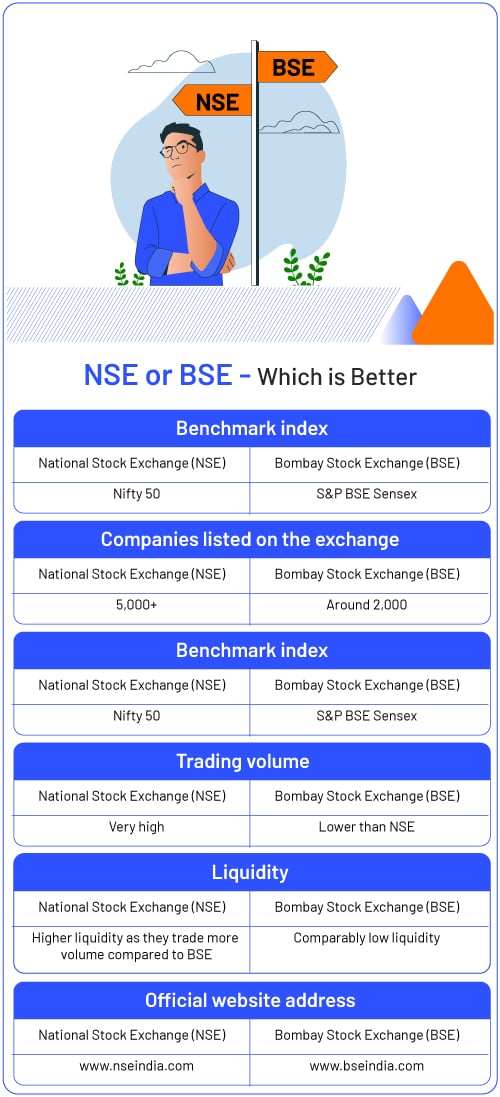
The difference between NSE and BSE is largely functional as opposed to operational. The two exchanges are controlled and subject to the same trading regulations. Both platforms have many large companies listed. It is a common phenomenon in NSE when there is increased volume of trading in actively traded stocks and hence tighter bid and ask spreads.
BSE is older, and it has a larger list of companies, including quite a number of smaller firms. To the majority of retail investors, the process of buying and selling in either of the exchanges is the same. This selection is usually pegged on the liquidity within a given stock, as opposed to the exchange.
|
|
NSE |
BSE |
|
Trading Volume |
More |
Lesser than NSE |
|
Liquidity |
More |
Lesser than BSE |
|
Index |
Nifty |
Sensex |
|
Few |
Large list |
1. Trading Volume: As seen above, NSE has significantly higher trading volume; this implies that many buyers and sellers for stocks are readily available. On the other hand, BSE has a lower trading volume for most equity segments.
2. Liquidity: NSE has superior liquidity compared to BSE, which makes it a better choice for active traders. Higher liquidity ensures easier trade execution with minimal price impact, providing more opportunities to convert stocks into cash efficiently.
3. Stocks: BSE has a gigantic list of stocks; the majority of Indian listed companies are part of BSE; nearly all stocks that are part of NSE are also part of the BSE list.
4. Derivative Contracts: NSE Nifty and Bank Nifty are highly traded thanks to their massive liquidity. While NSE has historically monopolised the derivative contract segment, BSE has recently gained significant market share with its renewed Sensex and Bankex contracts.
Read More: Difference between NSE and BSE
Conclusion
The decision on whether to invest in NSE or BSE does not involve heavy analysis on the part of most investors. They are both regulated by the same framework and offer the availability of listed companies in industries. When a stock is traded in both markets, the price difference is typically not significant as the market is efficient. Novices are able to pay more attention to the basics of the company, the risk profile, and long-term objectives, as opposed to being concerned about the exchange. Disciplined investing and informed decision-making are much more important than the exchange name.
Read More: NSE and BSE Meaning
