
 EN
EN
Regular saving is not sufficient to plan future costs. Increasing prices decrease the real worth of the money which is not invested. Investing is one of the aspects in this area. The stock market is one of the possible variants because it is accessible and can be developed. The benefits of investing in the stock market are that the investor is part of the business development, they can sell and buy anytime, and they have the opportunity to generate revenue as well as an increase in price. In the long run, stocks assist the investor to adjust the risk and returns as well as remain consistent with the fluctuating financial objectives and market environments.
Key Takeaways
-
Offers high liquidity, allowing easy buying and selling through active Indian exchanges
-
Provides diversification and flexibility across shares, bonds, funds, and derivatives
-
Enables capital growth and dividend income over short and long periods
-
Gives ownership rights with regulatory protection, supporting informed investing decisions
Higher Liquidity
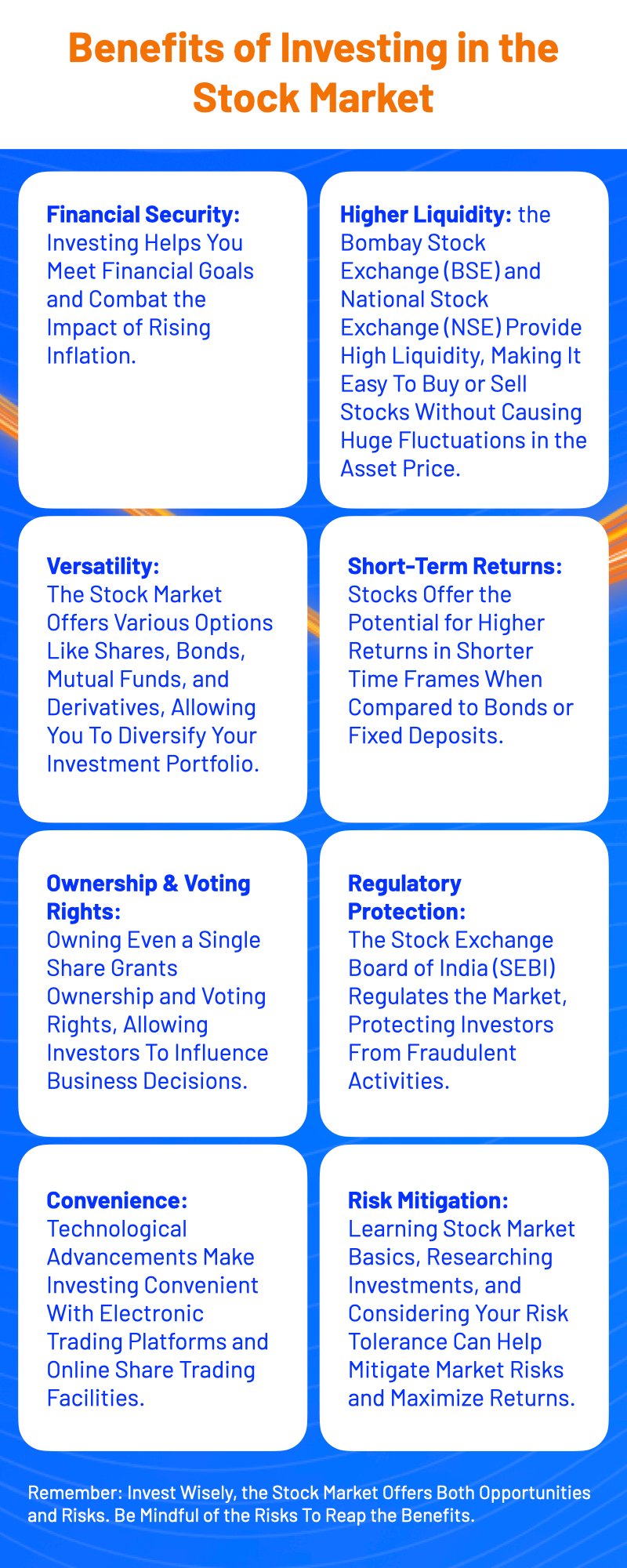
In the Indian stock market, two exchanges, the Bombay Stock Exchange (BSE) and the National Stock Exchange (NSE), play important roles. Most companies trade their shares on either or both of these exchanges. This provides higher liquidity to investors because average daily volumes are high. Therefore, if an investor wants to buy or sell any financial instrument on the stock exchanges, this liquidity makes it easy.
Also Read: What is NSE and BSE?
Versatility
The stock market offers different financial instruments, such as shares, bonds, mutual funds, and derivatives. This provides investors with a wide choice of products in which to invest their money. In addition to providing investment choices, this flexibility is beneficial in mitigating the risks inherent to stock investing by enabling diversification of investment portfolios.
Potential To Earn Higher Returns in Shorter Periods of Time
Compared to other investment products like bonds and fixed deposits, stock investing provides investors an excellent possibility of making greater returns. Adhering to the stock market basics, such as planning the trade, using stop-loss and take-profit triggers, doing the research and due diligence, and being patient, can significantly mitigate the risks inherent to stock investing and maximise the returns on share market investments.
Acquire Ownership and Right to Vote
Even if an investor acquires a single share in a company, he acquires a portion of ownership in the company. This ownership, in turn, provides investors the right to vote and offer their contribution in the strategic movement of the business. Although this may seem like an exaggeration, it is true, and there are several instances when shareholders have prevented company management from making unreasonable decisions that are detrimental to their interests.
Regulatory Environment and Framework
The Indian stock market is regulated by the Securities and Exchange Board of India (SEBI). The SEBI has the responsibility of regulating the stock exchanges, their development, and protecting the rights of the investors. This means when investors invest in financial products on the stock market, their interests are well-protected by a regulatory framework. This significantly helps in reducing risks due to fraudulent activities of companies.
Convenience
Technical development has influenced every aspect of modern living. The stock exchanges are also using various technical advancements to provide greater convenience to the investors. The trades are all executed on an electronic platform to ensure the best investment opportunities for investors in an open environment. In addition, broking service providers offer online share trading facilities that make investing convenient, because investors can place their orders through a computer from the comfort of their homes or offices. The demat account makes it easier for investors to hold all the products within their investment portfolio electronically in a single location, which makes it easier to track and monitor the performance.
Dividend Income
Dividend income is the amount of money that companies pay to shareholders as a part of their profits. Numerous older companies distribute a part of the income to investors in the form of dividends, thus offering them a fixed stream of money without the need to sell shares. Such a source of income may be used to cover routine costs or can be reinvested in order to grow the holdings in the long run. Dividend income is usually associated with stable companies that have regular policies of paying dividends. To long-term investors, dividends bring predictability to returns and minimise the dependence on movements in market prices. Reinvested dividends may be significant contributors to the growth of a portfolio in the long run.
Although stock investing has several benefits, investors must also be cautious while making their decisions. Understanding the stock market basics and doing their research before investing is advisable to mitigate risks and maximisee returns.
Also Read: What is a Shareholder?
Conclusion
The benefits of stock market investing are flexibility, opportunity for growth and income. Stocks enable investors to be part of the development in the economy and control entry and exit options. The stock market provides various options, whether one wants to invest in long-term appreciation or the dividends given on a regular basis. There are risks, but uncertainty can be dealt with through informed decisions, time and diversification. To those who are open to education and do not tend to lose patience, the stock investment can be used to help in financial planning during various stages of life without tying up money in definite fixed-term periods and restricting access to capital.
