

IPO grading is an independent evaluation of a company’s fundamentals, carried out by a registered credit rating agency, to assist investors in assessing the overall quality of the company issuing shares. It helps reduce information gaps between companies and investors by presenting a structured assessment based on defined criteria.
IPO grading remains optional in India and companies may choose whether to obtain it. Even when available, investors should use IPO grading as one part of their overall analysis, along with the prospectus, risk disclosures, and personal investment objectives, before making any decision.
Key Takeaways
-
IPO grading is no longer a mandatory regulatory requirement and SEBI now allows for voluntary disclosure.
-
Grades are assigned on a scale of 1 to 5, where higher grades indicate stronger fundamentals relative to other listed equity shares in India
-
IPO grading does not consider the issue price and does not guarantee returns or predict listing performance.
-
IPO grading is optional in India and should be used along with the prospectus and risk disclosures for informed investment decisions.
What Is IPO Grading?
IPO grading is the professional assessment done by a SEBI-registered Credit Rating Agency (CRA) on the fundamentals of a company in relation to the other listed equity shares in India. CRAs assign a grade on a scale of 1-5, indicating the fundamentals of the company.
Check Out: Upcoming IPO
How Does IPO Grading Help In Deciding About Investing In An IPO?
IPO grading is intended to provide the investor with an informed and objective opinion, expressed by a professional credit rating agency after analysing factors like business and financial prospects, management quality, corporate governance practices, etc.
However, irrespective of the grade obtained by the issuer, the investor needs to make their own independent decision regarding investing in any issue after studying the contents of the prospectus, including risk factors, carefully.
Importance Of IPO Grading
IPO grading plays an important role in helping investors understand the overall quality and fundamentals of a company before investing. It provides an independent and structured assessment based on financial, operational, and governance factors.
-
Assesses company fundamentals: IPO grading helps investors understand the company’s financial strength, business stability, and overall performance before making an investment decision.
-
Improves transparency: It highlights key areas such as financial health, growth potential, industry position, and corporate governance, helping investors gain clearer insights.
-
Provides independent evaluation: IPO grading is conducted by registered credit rating agencies, offering a structured and independent assessment based on defined financial and operational factors. Investors should note that rating agencies are typically engaged by the issuing company, and grading should therefore be considered alongside other available disclosures.
-
Ensures easy access to information: IPO grades and detailed explanations are available in the company’s prospectus, abridged prospectus, and official issue-related disclosures.
-
Supports informed decision-making: IPO grading remains optional in India, and investors should use it along with the prospectus, risk factors, and personal analysis rather than relying on it alone.
Read More: What Is IPO
The Process Of IPO Grading: From Evaluation To Rating
IPO grading follows a structured process where a registered credit rating agency evaluates the company’s overall fundamentals. The purpose is to provide an independent assessment of the company’s financial strength, management quality, and business prospects.
The grading process involves a detailed analysis of financial statements, business model, industry position, and future growth potential. Agencies review factors such as revenue performance, profitability, cash flows, corporate governance practices, and risk exposure. Based on this evaluation, a grade is assigned on a five-point scale to reflect the company’s relative fundamental strength.
-
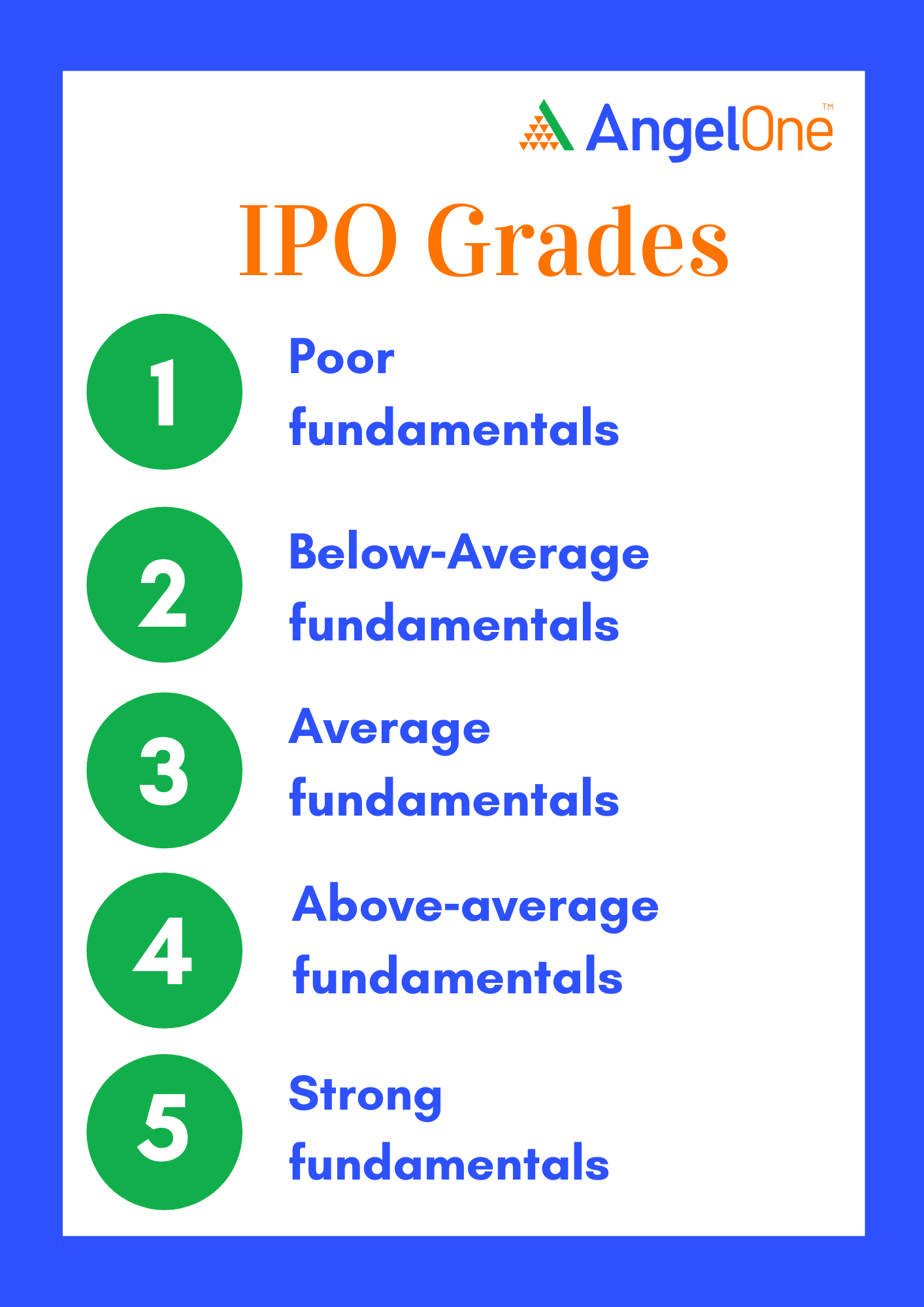
Grade 5 – Strong fundamentals
-
Grade 4 – Above-average fundamentals
-
Grade 3 – Average fundamentals
-
Grade 2 – Below-average fundamentals
-
Grade 1 – Weak fundamentals
IPO grading does not consider the issue price or expected listing performance. IPO grading is optional in India and should be used along with the prospectus and risk disclosures.
Read More: IPO Process
What Are The Factors Considered In IPO Grading?
The list of areas that are generally looked into by the Credit Rating Agency while arriving at an IPO grade includes:
-
Business Prospects and Competitive Position
-
Industry Prospects
-
Company Prospects
-
Financial Position
-
Asset and liabilities
-
Annual reports
-
Balance Sheet
-
Operating cash flows
-
Management Quality
-
Hedged risks
-
Corporate Governance Practices
-
Promoters’ profile
-
Company’s marketing strategies
-
Competitive advantage
-
Growth prospects
-
Technological initiatives
-
Operational efficiency
-
Compliance and Litigation History
-
New Projects-Risks and Prospects
Remember that the IPO grading process varies on a case-by-case basis.
What Are The Grades?
The grades are allocated on a 5‐point scale, the lowest being Grade 1 and the highest being Grade 5. The higher the grade, the stronger the fundamentals of the company.
When Shouldn't Grading Be Used?
IPO grading provides useful insights into a company’s fundamentals, but it should not be treated as the only basis for investment decisions. It evaluates overall strength and not market behaviour or future returns.
-
Making subscription decisions alone: IPO grading is not a recommendation to subscribe to or avoid an IPO.
-
Forecasting listing performance: It does not predict whether the share price will rise or fall after listing.
-
Determining issue price suitability: IPO grading does not consider the valuation or pricing of shares.
-
Detecting fraud or irregularities: It is not designed to identify fraud, legal violations, or undisclosed risks.
Investors should always review the prospectus, risk factors, and financial disclosures along with IPO grading before making a decision.
Note:
-
An IPO grade is not a suggestion or recommendation as to whether one should subscribe to the IPO. IPO grade needs to be read together with the disclosures made in the prospectus, including the risk factors, as well as the price at which the shares are offered in the issue.
-
IPO grading is done without taking into account the price at which the security is offered in the IPO. The investor needs to make an independent judgment regarding the price at which to bid for the shares offered through the IPO.
-
IPO grading is optional with effect from 04-Feb-2014.
It is essential to evaluate the quality of an investment before committing capital. IPO grading serves as an efficient tool to understand the company’s fundamentals. The IPO grading process helps companies improve transparency ahead of a public listing. IPO grading, along with other disclosures made by the company, gives investors insight into the risk profile of the company.
Conclusion
IPO grading provides an independent evaluation of a company’s fundamentals, helping investors understand its financial strength, management quality, and overall business stability. It reflects the company’s relative position based on financial and operational factors, but does not consider the issue price or future market performance.
IPO grading should not be used as the sole basis for investment decisions. Instead, investors should review the prospectus, risk disclosures, and financial details along with the assigned grade to gain a complete understanding and make informed investment decisions based on multiple relevant factors.
