
How Elections Sway Foreign Investor Sentiment in India


Foreign Portfolio Investors (FPIs) play a crucial role in the Indian stock market. Their investment decisions can significantly impact market volatility and overall health.
Our analysis reveals a mixed picture. While there’s no clear, consistent pattern across all elections, the data suggests some interesting trends. In the 2014 elections, FPI net total flows were positive before the election and even higher three months after, indicating investor confidence in the post-election scenario. Conversely, the 2009 election witnessed negative net flows before the election, followed by a positive swing afterward. This could be attributed to the global financial crisis that year, impacting overall investor sentiment. In the 2004 elections, FPI inflows reduced significantly three months after the elections, indicating reduced interest by FPIs in Indian markets.
The following table illustrates the FPI net total flows data three months before the starting month of elections and three months after the end of the election month. Net total flows encompass both equity and debt inflows and outflows.
| Elections | FPI Net Total Flows (Rs crore) | ||
| From | To | Before 3 months | After 3 Months |
| 19 April, 2024 | 01 June, 2024 | 77,220 | – |
| 11 April, 2019 | 19 May, 2019 | 55,248 | 4,237 |
| 07 April, 2014 | 12 May, 2014 | 57,727 | 88,885 |
| 16 April, 2009 | 13 May, 2009 | -12,454 | 22,610 |
| 20 April, 2004 | 10 May, 2004 | 12,986 | 2,966 |
The upcoming 2024 election presents a unique case. Data for the pre-election period (three months before) shows positive net inflows, potentially reflecting optimism about the Indian economy and a stable government post-election. However, data for the post-election period is yet to be available. But according to GDP growth estimates of various brokerages, IMF and RBI the fund inflows are expected to be positive given the outperformance of the Indian economy despite geopolitical issues prevailing in the global markets.
Beyond the Numbers: Factors at Play
Understanding FPI behavior requires considering various factors beyond just election timing. Here are some key influences:
- GovernmentPolicies: FPIs closely monitor government policies that impact business regulations, foreign investment regulations, and overall economic stability. A clear and stable policy framework fosters investor confidence.
- MacroeconomicConditions: Inflation, interest rates, and GDP growth significantly influence investment decisions. A robust and growing economy attracts foreign capital.
- GlobalMarketTrends: Global market volatility, interest rates in developed economies, and global risk aversion can impact FPI flows into emerging markets like India.
- DomesticMarketPerformance: The attractiveness of the Indian stock market itself plays a role. Strong corporate earnings, attractive valuations, and a well-developed regulatory framework can entice FPIs.
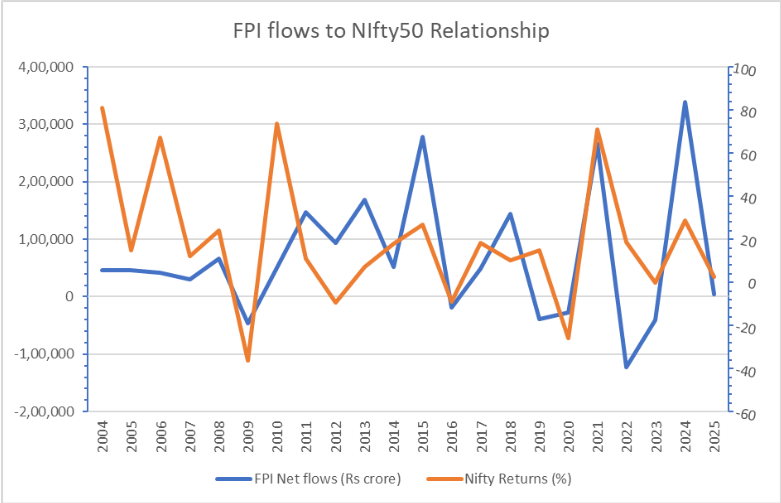
Nifty50 relationship with FPI flows
The FPI net flows relationship with Nifty50 is somewhat directly related as FPI flows increase the Nifty50 returns increase but at a lower proportion
DII stakes rise, FII Influence Wanes
In recent years, there has been a significant shift in the ownership of Indian companies. Foreign Institutional Investors (FIIs) have been steadily decreasing their holdings, while Domestic Institutional Investors (DIIs) have been aggressively buying. This trend is evident in the record inflows into mutual funds and pension funds. Fueled by this domestic financialization
According to the data from primeinfobase.com, DII holdings have been on the rise, while foreign ownership has dropped in the past 10 years. Domestic institutional holdings in NSE-listed companies increased to 15.96% in December 2023 as against 13.77% in December 2018 or 10.49% in December 2013. Foreign holdings in NSE-listed companies were at 18.19% as of December 2023 down from 19.66% in December 2018 or 19.36% as of December 2013. FIIs holding hit a peak of 21.21% in December 2020.
This narrowing gap, with DIIs just 12.23% behind FIIs, suggests a potential future where domestic investors hold a larger sway in the Indian market. This shift in ownership has a crucial implication: the impact of FII inflows and outflows, which previously caused significant market volatility, is likely to be dampened as DIIs become a more prominent and stable source of investment.
Conclusion
In conclusion, while no consistent pattern emerges across all elections, the analysis reveals nuanced dynamics influenced by global and domestic factors. Moreover, the discussion on the evolving ownership landscape, with DIIs gaining prominence over FIIs, underscores the shifting dynamics of the Indian stock market. As DIIs continue to assert their influence, the impact of FII inflows and outflows on market volatility is expected to diminish.
Disclaimer: This blog has been written exclusively for educational purposes. The securities mentioned are only examples and not recommendations. The information is based on various secondary sources on the internet and is subject to change. Please consult with a financial expert before making investment decisions.
Published on: Apr 18, 2024, 6:11 PM IST

- Goa Slashes VAT on Aviation Turbine Fuel to 7% from October 24, 2026
- India's Net FDI Inflows Reach $13.8 Billion in April-August FY27: RBI
- NRI Deposit Inflows Hit $121.94 Billion as FCNR(B) Deposits Rise: RBI Data
- Tamil Nadu Cuts VAT on Aviation Turbine Fuel at Chennai Airport from 29% to 16% to Reduce Airline Operational Costs
- India Notifies New Telecom Sandbox Rules to Support Technology Testing
Related Articles



Enjoy ₹0 Account Opening Charges
Get the link to download the App


