
Why the 4% Rule Fails in India: How Much Will You Need at 55 If You Spend ₹50,000/Month Today?


The 4% rule is a retirement planning guideline that suggests: You can safely withdraw 4% of your retirement corpus annually (adjusted for inflation each year) to ensure that your money lasts.
It originated from a 1994 study by William Bengen, a U.S. financial planner, based on historical data of U.S. stock and bond returns. The assumption was that if a retiree withdraws 4% of their corpus in the first year and adjusts the amount annually for inflation, their money would likely last through retirement.
Example of How the 4% Rule Works:
Suppose you want to retire with ₹10 lakh annual expenses.
- Using the 4% rule, your required retirement corpus = ₹10 lakh ÷ 0.04 = ₹2.5 crore.
Read More: Is Your Savings Account Losing You Money? A Look at Inflation, Opportunity Cost, and Low Interest Rates.
Why the 4% Rule Doesn’t Work Well in India
- Inflation in India is Higher and More Volatile
- Currency and Lifestyle Changes
India-Specific Example
You’re 30 today, and your monthly expense is ₹50,000 (₹6 lakh/year). You want to retire at 55, and assume inflation at 6%.
At age 55, your annual expenses will be based on the inflation rate of 6%:
₹25.75 lakh/year
Using the 4% rule, the required corpus =
Corpus=₹25.75 lakh/0.04 = ₹6.44 crore
So, you would need ₹6.44 crore in retirement savings to safely withdraw ₹25.75 lakh/year under the 4% rule.
Most people mistakenly assume ₹6 lakh/4% = ₹1.5 crore, which will run out quickly due to inflation.
Conclusion
The 4% rule is too simplistic for Indian retirement planning. It ignores:
- Higher inflation,
- Medical inflation,
- No state pension or safety net,
- And volatile return patterns.
Instead, Indians should consider a more dynamic withdrawal strategy or use goal-based planning tools tailored to inflation-adjusted expenses and longevity.
Disclaimer: This blog has been written exclusively for educational purposes. The securities mentioned are only examples and not recommendations. This does not constitute a personal recommendation/investment advice. It does not aim to influence any individual or entity to make investment decisions. Recipients should conduct their own research and assessments to form an independent opinion about investment decisions.
Investments in the securities market are subject to market risks, read all the related documents carefully before investing.
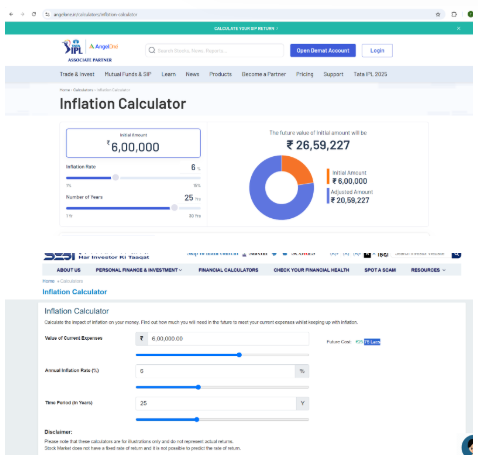
Why we have taken SEBI’s calculator
Reason being there was a stark difference between the two, attached is the screen shot.
Published on: May 5, 2025, 3:36 PM IST

Team Angel One

- Bajaj Life Insurance Launches Global Wealth Builder Policy Through GIFT City
- Can ₹2,500 a Month Grow to ₹2 Crore? Step Up SIP Calculator Explains the Maths
- Department of Posts Approves 60-Day Bonus for Eligible Employees for 2025-26
- EPFO Scheme: ₹15,000 Incentive for First-Time Employees Under Pradhan Mantri Viksit Bharat Rozgar Yojana
- SGB 2020-21 Series VII Delivers 192% return as RBI Opens Premature Redemption on October 19, 2026
Related Articles



Enjoy ₹0 Account Opening Charges
Get the link to download the App


