
 EN
EN
The question that many parents pose is, can a minor apply for an IPO offering in India? The answer is yes, of course, but not single. A minor has no right to conclude contracts independently; therefore, their representative is a parent or a legal guardian.
Investing in an IPO in the name of a child can become a tool for accumulating assets at a tender age and bringing money into the family. A demat account operated by the guardian holds shares allotted in the name of a minor. All the transactions are under supervision until the child reaches the age of eighteen. The process is regulated by clear regulatory rules with the help of proper documentation and accounts.
Key Takeaways
-
Minors can apply for IPOs through a guardian using a Demat and bank account in the child’s name.
-
Applications follow standard IPO rules, with added KYC and documentation for both minor and guardian.
-
Income from minor investments is clubbed with the parents’ income for tax purposes.
-
At 18, the minor account converts into a regular Demat account with independent control.
How to Apply for an IPO in a Minor’s Name
Parents often wonder, can a minor apply for IPO without complications? The process is structured but simple when accounts are set up correctly. Financial guidance platforms explain that the guardian completes the application on behalf of the child.
Step 1: Choose the IPO and Apply
The guardian reviews the offer document, price band, and lot size. Once the IPO is selected, the application is initiated through the trading platform linked to the minor’s Demat account. The PAN and details used must belong to the minor.
Step 2: Fill in the Application Form
The form requires the minor’s name, PAN, Demat account number, and bank details. The guardian’s details appear as the operator. Accuracy matters because any mismatch between PAN, bank, and Demat details may lead to rejection.
Step 3: Documents Required
KYC documents for the minor and guardian are necessary. These usually include PAN cards, Aadhaar, proof of address, and birth certificate. The guardian declaration confirms authority to operate the account.
Step 4: Submit the Application and Payment
Payment is made from the minor's or guardian’s linked bank account through ASBA. Funds remain blocked until allotment. If shares are allotted, they are credited to the minor’s Demat account. If not, the blocked amount is released.
Read More: What Is IPO
Documents Required for Minor's IPO Application
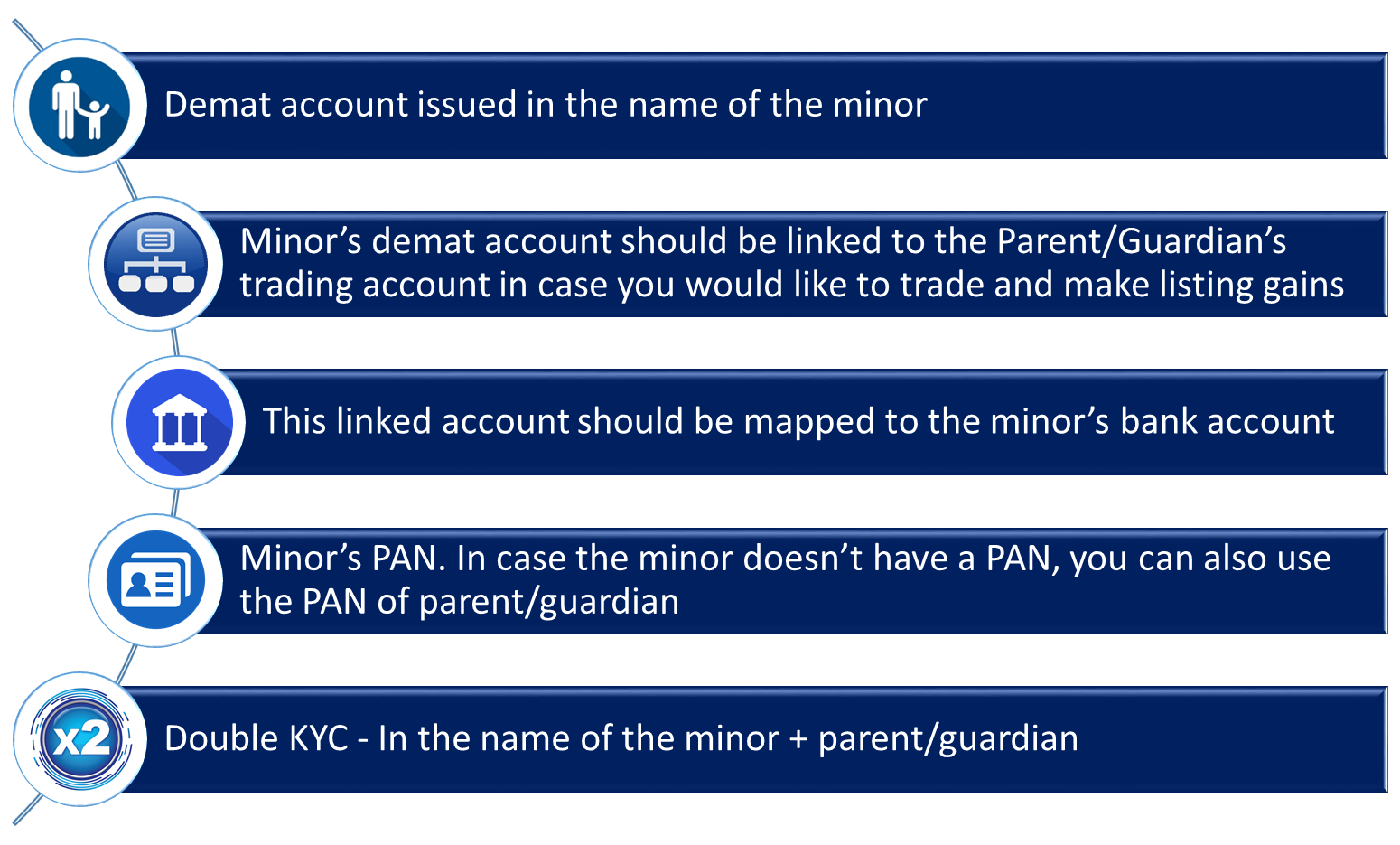
A minor IPO application requires specific documents for compliance. The minor is required to have a PAN card and a Demat account in their name and attach a guardian to it. An age confirmation comes with a birth certificate. The guardian's PAN, Aadhaar, and address documentation are also required.
This bank account should be in the minor's name and managed by the guardian. KYC completion for both parties is required before applying. Some intermediaries may request photographs and proof of signature. Clear and matching records reduce the risk of rejection during verification and allotment. Once these requirements are in place, you can complete the IPO application like you usually do. Do remember that you can submit only 1 Application per PAN - per Bank Account.
What Happens When the Minor Turns 18?
On completion of 18 years of age, the minor can choose to either:
-
Convert their minor Demat account to a major one by replacing the details of their parents/guardian with their own
-
Close the minor account and open a new one
Read More: Upcoming IPO
Should You Invest in IPOs Using Your Child’s Name?
Whether IPOs or otherwise, it is important to clearly understand why you are choosing a particular investment. For instance, if you are looking at making an early start towards your child’s financial future, then you can capitalise on IPOs’ potential to generate wealth over the long term through the power of compounding.
However, if you are looking for tax relief by investing in IPOs in the name of your child, then you should remember that any income or capital gains that are generated while they are a minor will get clubbed with that of the higher-earning parent. And then, accordingly, you will need to pay the requisite tax based on your own income tax slab or the flat capital gains tax rates (currently 20% for short-term and 12.5% for long-term gains exceeding ₹1.25 lakh).
So, evaluate your objective and purpose before you make any investment decision - especially considering your child’s future and the fact that significant tax advantages only begin once the child turns 18 and becomes a separate taxpayer.
Conclusion
A demat account for minor can be opened and the parents can begin investing on behalf of their child under a controlled system. The IPO shares assigned in the name of the minor are transferred into the custody of the guardians until the child turns 18. Once the child is 18, the account will be transformed into a regular Demat account after KYC procedures. It’s important to remember that early investment does not eliminate risk, but only gives time to work in favour of capital growth.
